
Dad
My father left this world in 1986, after thirteen long years of illness that slowly took his strength but never quite managed to erase his quiet dignity. My mother walked beside him through every one of those years, tending to him with a faithfulness that taught me more about love than any sermon or book ever could. He was 68 when he died, and yet in my mind he is frozen somewhere between strong and fragile—still my father, but already halfway to heaven.
During those hard years, my brother Jerry and I did the one thing we knew how to do: we showed up. Twice a year, every year, we drove back home, eight hours away—Jerry in June and December, I in March and September—each time with our families in tow, knowing there was a handwritten list of chores waiting on their kitchen table. We fixed what was broken, carried what was heavy, and tried, in our small way, to ease the weight that illness had laid on our parents’ shoulders. It wasn’t grand or heroic. It was simply love in work clothes, our way of saying, without many words, “You are not facing this alone. ”
When Dad finally slipped away, grief settled over me like a thick winter coat—heavy, stifling, impossible to ignore. I let myself wear it fully for two months. Then, remembering the man who always told us to keep going, to do our duty and live our lives, I made the choice he would have wanted for me. I loosened my grip on the grief, but I never loosened my grip on him. I carried him forward, not in photographs or keepsakes, but in the quiet, invisible place where a child keeps a parent long after the world has said goodbye. Forty years have passed since then, and still, he walks with me.
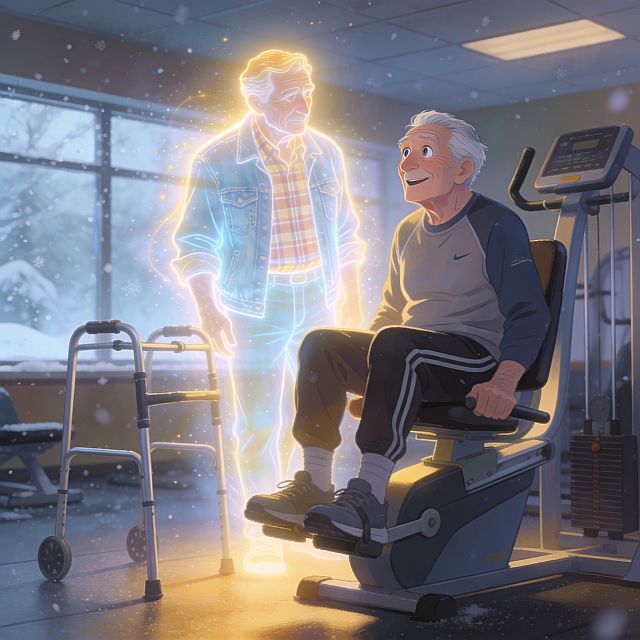
A few weeks ago, on a lazy winter afternoon, I wandered into the gym on our retirement campus for an ordinary workout. The room was nearly always mine alone, a place of routine and repetition. But that day, another man was there, a bit older than I am now, moving from machine to machine with the patient determination of someone who has learned that every step taken is a small victory. I noticed him and began my exercises, my mind on sets and repetitions, not on memory.
About halfway through, I looked up and caught his profile. In that instant, something unnamable stirred. A warmth rushed through me, from my chest out to the tips of my fingers, like a door had quietly opened in my heart. For a heartbeat or two, I was no longer just an aging man in a quiet gym. I was a son again, and my father was in the room. Forty years fell away as if they had been only a long, strange dream, and I felt—deeply, impossibly—that we could speak at last, that time had bent enough to allow one more conversation.
I stopped what I was doing and simply sat there, held in that fragile moment. I watched him write notes on a piece of paper resting on the seat of his walker, watched the familiar slowness of his movements, and inside me a voice cried out, “Dad, it’s me. Don’t you know who I am?” It was a plea born of love and regret, of all the words never spoken and the questions that have lived, unanswered, in my chest for decades.
Then he turned. I saw his face full-on. He was not my father. The spell broke gently, like a bubble touched by air, and the warm, wondrous feeling that had filled my heart began to flutter away. The gym was just a gym again—two strangers sharing machines on a wintry afternoon. And yet something had shifted in me.
In my life, I’ve had a few surreal moments—dreams where departed relatives visited me, their faces luminous with something like peace. But those visits came in sleep, in the hazy country between memory and imagination. This was different. I was wide awake. And for days after, that encounter would not let me go.
As I turned it over in my mind, I began to understand the quiet gift hidden inside it. That brief glimpse, that mistaken recognition, reminded me just how much I loved my father, how present he still is in the architecture of my life. It reminded me that love does not end where a pulse does; it simply moves into a different language, one spoken in memory, in echoes, in sudden waves of feeling that rise up when you least expect them.
My father was not a perfect man. No father is, and I know now that no son is either. He had his share of flaws, and the sharpest of them was his struggle with alcoholism. It shaped our family in ways I did not fully understand as a child. There were things he could not give us: warmth he could not always express, steadiness that slipped through his fingers. For many years, I held that against him. I mistook his weakness for a lack of love, his addiction for a choice made against us rather than a battle he was losing within himself.
Now, as a father myself, with my own shortcomings and regrets, I see his humanity with gentler eyes. I have come to realize that our parents are not gods or villains; they are simply people standing in front of us, doing the best they can with the wounds and burdens they carry. The wisdom of age has taught me that love and hurt often live side by side in the same story, and that forgiveness is not a way of excusing the past but of freeing the heart to love more honestly.
If I were granted one minute—just sixty small seconds—with my father again, I know now how I would spend it. I would not waste time on blame or questions that cannot be answered. I would look into his eyes and tell him I am sorry for the anger I held, sorry for the harsh judgments I nursed in the dark corners of my mind. I would tell him I understand a little more now, that I see the man behind the struggle, and that I am grateful for what he gave us: a home, a name, and a place in the world.
And then I would step forward and wrap my arms around him, holding on with all the strength these years have left me. I would hug him so tightly that, just for that moment, nothing—not time, not illness, not regret—could come between us. I would let him know, without a single doubt, that I love him, that I have always loved him, even when my hurt spoke louder than my heart.
I cannot have that minute with him in the way I wish. But perhaps, in that gym, I was given another kind of mercy: a reminder that it is never too late to soften, never too late to forgive the ones who shaped us, never too late to honor the complicated love that made us who we are. My father is gone, and yet he lives on—in my memories, in my choices, in the way I love my own family. And sometimes, on a quiet afternoon, in an ordinary room, he steps close enough for me to feel him again.