
My Grandpa’s Dilemma
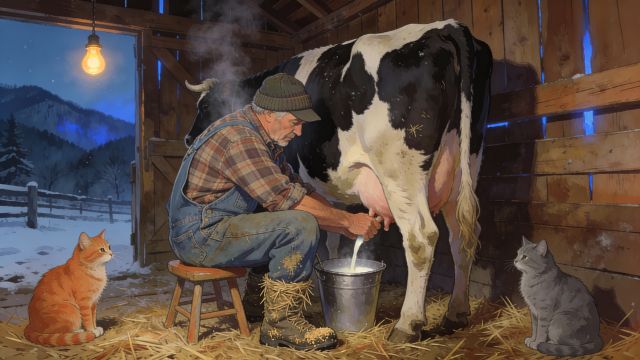
The night sky over Clell, Virginia, hung low with stars, a frosty bowl of light over the narrow valley. The Big Ben alarm clock on the table ticked loudly in the silence, its steady beat the only sound besides George’s breathing and Mary’s gentle snoring. At 5:00 a. m. the alarm shattered the stillness.
George flung out a hand, missed the clock, and sat up with a groan. His bare feet hit the cold floorboards, the chill running through him like a knife. The fire in the potbellied stove was little more than a dull red eye. He shuffled over, fed it a couple of split oak sticks and a scoop of coal. Sparks leaped, flame followed, and a faint warmth crept into the room.
“Time to get up already?” Mary mumbled from under the quilt.
“It’s what that darn clock says,” he replied.
She yawned, rolled over, and put her feet on the floor. George smiled, the lines at the corners of his eyes deepening. He’d been waking up to that same clock and that same woman for a long time.
Outside, January had its boot on the neck of southwest Virginia. Six or eight inches of snow lay over their little farm, wind-smoothed into curves and glazed hard by yesterday’s sun.
George had pulled on his long-johns in October, as he did every year, and he wouldn’t peel them off until April was honest about spring. Winter kept a farmer busier than most folks reckoned—animals didn’t care what the calendar said, and milk and eggs didn’t wait on weather.
He dressed in the half-dark, sliding into his shirt and bib overalls, his mind already running down the day’s chores: milk the cow before daylight, check the hogs and the sow with her new litter, break the ice on the water trough, see if the winter garden had frozen solid or if he could still worry at it with his hoe. He pulled on heavy wool socks and his old brogans.
He lifted the curtain and peered out. The stars were scattered bright and hard, like chips of ice on black glass. The clouds had moved on; the real cold had moved in. He could feel it through the window.
As he buttoned his coat and wrapped a scarf around his neck, he thought of his children. Six of them—three boys, three girls—grown now, scattered across the hills and valleys as if thrown by a careless hand. All married, all with children, except the youngest, Beulah, away at college writing letters about professors and books that sounded as foreign as another country. All but her lived within easy reach of home.
He paused with his hand on the doorknob, his gaze falling on Mary in the dim dawn light. Not everybody had a love story, but he and Mary did. They’d weathered crop failures, injuries down at the mines, a baby’s fever that had them riding in the dark to a doctor. The hard years had pressed them closer instead of pulling them apart. Gratitude and fear ached together in his chest—gratitude for the years they’d had, fear that time was running faster than the clock on the table.
He opened the back door and stepped into the predawn with his milk pail in one hand and a kerosene lantern in the other. Behind him, Mary stirred; stove lids clinked as she began her own morning’s work—kindling, coffee, biscuits, sausage, eggs. Breakfast here was no light affair; it took fuel to push a man through winter chores and into the long afternoon.
The snow squeaked under his boots, the high, tight sound telling him the temperature without a thermometer. He moved carefully, testing each step. A fall in the half-light could mean a broken hip and no one to hear him call.
After thirty or forty yards, he heard the soft pad of small feet behind him. His two barn cats, gray, orange, and silent, slipped into his wake. He never bothered with names—they came when they wanted and left when they pleased—but they answered to the scrape of the barn door and the sound of milk hitting a pail.
The lantern threw a small circle of gold as he reached the barn. He slid the door open, and the cats shot inside, streaks of fur heading for the warmest corners. The smell of hay, manure, and animals wrapped around him, as much home as coffee and wood smoke.
He checked the hogpen first. The sow lay on her side, panting, while ten piglets worked at her belly, little bodies twitching with satisfaction. In three weeks, they’d be fifteen pounds; in five or six months, he’d choose two for slaughter and send the rest to market. Their future was measured in pounds and dollars. The money from those pigs could mean the difference between paying for Beulah’s books or asking her to come home and teach school like her sisters.
George had not always farmed full-time. For years he’d gone down to Page, five miles away by the winding dirt road, to work the coal mines with his three sons. The darkness, dust, and constant ache had worn him down. After a cave-in killed one man and broke another’s back, he had stood in the lamplight at the mouth of the mine and realized that if he kept going in, he might not come back out. His father had farmed—sunlight on his face, hands in the soil, a Bible at his bedside. That seemed a better way to wear out a body.
So George left the mines. It meant less ready cash, more worry over weather and disease, but he could stand in his own fields and feel the land answer under his boots. They were never wealthy, but the pantry had food, the roof held, and the children had shoes and schoolbooks. Around Clell, he was known as a man of his word, and that sort of wealth counted.
He set the lantern on a nail in a post, reached for his milking stool, and settled beside the cow. She turned her mild eyes toward him, steam rolling from her nostrils into the cold barn air.
“Mornin’, old girl,” he murmured, his hands already working. “You give the milk; I keep you warm, fed, and sweet-talked. ”
The cow shifted and settled. The sound of milk hitting the pail grew steady and strong. This milk was their lifeblood—Mary’s butter and buttermilk brought in a little money, and sweet milk filled the jars that went home with the children after Sunday dinner.
The cats slunk closer. When the pail was nearly full, George pinched a teat and sent a warm stream of milk arcing through the lamplight. The cats rose on their hind legs, mouths open, catching what they could. He chuckled despite the cold.
“All right, that’s enough,” he said. “You’ll get more when Mary puts a pan out. ”
He finished, patted the cow’s flank, and filled her hay rack. Then he lifted the heavy pail, took the lantern, and pushed the barn door open with his shoulder.
Outside, the horizon had softened into gray-blue. The two mountains that hemmed in his world stood like massive shoulders. A thin ribbon of smoke climbed from the chimney, and from here he could just make out the faint clatter of pans—Mary at the stove.
He stepped into the cold, the pail swinging, the lantern light bobbing. Something felt wrong.
It wasn’t the temperature; it had been this cold before. It wasn’t the sound; everything was quiet, too quiet, except for the faint crack of ice in the creek. It was something in the air—a tension like the moment before a dog growls.
The hair on the back of his neck rose. George stopped. The cats, trotting at his heels, froze, ears pricked.
He turned his head slowly, careful of the milk and the lantern. At first, he saw only pale snow and black trees. Then, about seventy-five feet up the slope above the barn, he saw it.
A mountain lion. Big and tawny, its long tail curved behind it, twitching at the tip. Its body was low, muscles bunched mid-step. It was looking straight at him.
His breath hitched. He’d heard the stories—old men at the feed store talking about “panthers” seen at dusk, livestock gone missing, shadowy shapes on the ridgeline. The state always said no; there weren’t any cougars left in Virginia, just bobcats and big dogs and tales. But there it was in the snow, watching him with a predator’s calm.
For a moment, time went thin. He felt the weight of the pail, the lantern handle biting into his fingers, the cold air in his lungs.
The mountain lion’s eyes flicked from him to the cats and back. George knew enough about animals to understand that he stood somewhere on its list of possibilities. He wasn’t a deer or a rabbit, but he was meat, and he was older now, stiff in the mornings. It occurred to him, sharp and clear, that this might be the first morning he did not make it back to the house.
He forced himself to think. He had rocks near at hand; he had his voice; he had time to shout or throw. But he also had one other thing—the barn door behind him and what hung on its walls.
He set the milk pail down slowly and lowered the lantern, never taking his eyes off the cat. His heart pounded hard enough to make him lightheaded, but his hands stayed steady. The cats pressed against his boots, rigid with fear.
“Easy now,” he whispered, though he didn’t know to which creature.
He pivoted, grabbed the barn door, jerked it open, and shoved himself and the cats inside in one motion. The door slammed, the latch falling with a wooden thunk that sounded far too small to stop something that size. He leaned against the planks, breathing hard, listening.
Silence.
He swallowed and peered through a crack between the boards. The mountain lion had moved closer, maybe fifty feet away, head slightly lowered. It tested the air, nostrils flaring, then padded in a slow half-circle, as if examining the barn and the man who had slipped from sight.
George watched its eyes. There was no malice there, only hunger and calculation. It was no villain, just an animal with ribs that probably ached, driven down from higher ground by deep snow and scarce deer. Knowing it wasn’t evil did nothing to soften the danger. .
The lion paused, tail flicking, then turned its head toward the house. George’s gut clenched. Mary was in there, unaware. She would step out soon to shake a rug or empty dishwater, trusting the familiar yard and the fence.
He yanked his gaze away and looked around the barn. The pitchfork leaned in its usual place near the hay bin. A useless thing against a lion, perhaps, but it was steel and wood and reach. It was something.
Back at the crack, he saw the cat circle once more, sniff where he’d stood, then sit on its haunches. The disappointment in its stance was almost human. It had found scent and sound and promise, then had it whisked away behind boards.
They stared at each other through the gap, the distance between human and animal only an arm’s length and a plank’s width. George felt oddly naked, stripped down to something simple: a living thing that did not want to die yet.
The lion’s ears twitched. It huffed once, then rose. With a last look toward the barn door, it turned and trotted up the hill, snow puffing under its paws. In seconds it was gone, swallowed by the trees.
George stood still a few minutes, then he let out his breath.
He set the pitchfork aside. He could stay in the barn until full daylight, but Mary would worry and might leave the house to find him. And there was the milk cooling in the pail outside, drawing who knew what scavengers. The mountain lion might be gone, but the world was still full of smaller hungers.
He unlatched the door and eased it open, his eyes scanning the slope and the fence line. Nothing; only the pale wash of early light and the trail of paw prints leading into the trees.
The cats stayed just inside, courage ending at the threshold. George stepped out, grabbed the milk pail, lifted the lantern, and closed the barn door firmly after they scampered through, sliding the bar into place.
He started toward the house, walking a shade faster than usual, his senses wide open. The lion’s tracks were clear in the snow, each print a warning. He wondered how many times wolves or bears or cats had watched him from the trees over the years without his knowing. Maybe this morning wasn’t the first time he’d been weighed as prey, only the first time he’d seen the scale.
By the time he reached the porch, his mind was crowded with more than chores. The thread of their safety, which he’d always trusted as a given, now felt like a rope he had to grip.
He opened the door. The cats shot past him, suddenly brave with walls around them. Warmth washed over him. The smells of frying sausage, baking biscuits, coffee, and gravy wrapped around his senses like a quilt.
“You took your sweet time,” Mary said, standing at the stove with her apron on and her gray hair pinned back in its loose bun. “Biscuits ’ll be hard as rocks if you don’t sit down soon. ”
“Had to make sure the sow’s little ones all had a spot at the table,” he said, kissing her cheek. “It’s crowded in there. ”
He set the milk on the counter and the lantern on its hook, his eyes flicking to the window and the white slope beyond. If she knew what had stood out there watching him, she wouldn’t be worrying about cold biscuits.
He didn’t lie to Mary—not about money, sickness, or the children. Their life together had been built on too many thin boards and patched roofs for that. But this felt different. If he told her now, every sound outside would become a threat in her mind. Every step to the privy or henhouse, every walk down the lane, she’d have her eyes on the trees.
He sat at the table, the wood scarred by years of plates and elbows and children’s forks. The Big Ben clock ticked steadily in the next room. He wondered how many ticks were left for him, for Mary, for the children whose futures now stretched beyond this hollow into towns that had never heard a whippoorwill or seen the Milky Way.
“George?” Mary said, setting a plate in front of him. “You look like you’ve seen a ghost. ” He looked up at her. She was still pretty to him, lines and all.
“Just thinkin’,” he said. “Snow’s deeper than I thought. Chores’ll take a bit longer. ” He took a bite, the warmth of the food pushing some of the chill from his bones. Outside, the lion’s tracks were already beginning to soften at the edges as a faint wind lifted little veils of snow and carried them away.