
Scary Movies
My first brush with what I would later call a “scary movie” happened when I was five. At that age, imagination and reality melted together, and the world still felt like a place of wonder. On a quiet Sunday afternoon, my mother took me to the local theater to seeThe Wizard of Oz. What made the day special wasn’t just the film—it was that it was just the two of us. No siblings, no distractions, no chores waiting at home. Just a mother and her young son stepping out into what felt like a grand adventure.
I remember the theater vividly. It wasn’t large or fancy, but to me, it seemed enormous. The lobby was dimly lit, smelling of buttered popcorn and echoing with soft conversation. My mother bought us each a bag of popcorn and a Coke. I can still feel the waxy cup in my hand and hear the fizz of the soda as we found our seats near the front, where the screen stretched beyond my field of vision. It felt like a glowing window into another world, and I was eager to step through it.
At first, everything delighted me. The colors were brighter than anything I’d ever seen; the songs were joyful; the characters felt friendly. Dorothy’s journey was magical in the way only a child can fully embrace. But then something shifted.
As the story moved toward the Wizard’s palace, the tone darkened. The bright, comforting world began to feel uncertain, even threatening. When the Wizard appeared as a vast, unseen presence, his voice booming through the theater, I felt a sudden, overwhelming fear. He seemed impossibly large, his power absolute. But what frightened me most was his mystery—hidden behind a curtain, unseen yet all-powerful. My young mind had no way of making sense of that.
The unknown has a way of amplifying fear, especially for a child. Had I seen him clearly, I might have felt differently. But his booming voice and concealed identity made him feel almost supernatural, as if he didn’t belong in the world I knew.
I reached for my mother’s hand and squeezed it as tightly as I could. My knuckles turned white, and though she said nothing, I knew she felt my fear. She didn’t pull away, didn’t hush me, didn’t tell me to be quiet. She just let me hold on—silently giving me enough reassurance to stay in my seat and make it through the film.
When the lights came back up, I felt immediate relief, as though a weight had lifted. The danger was gone, the story was over, and the real world had returned. The screen was just a blank surface again. We gathered our things and walked out, stepping back into sidewalks and streetlights.
But something had changed.
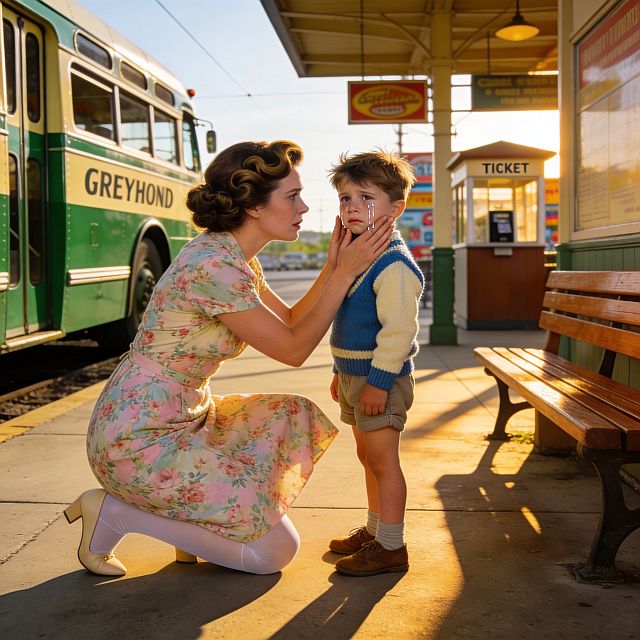
On the way to the bus stop, my mother was unusually quiet, her steps slower, her expression more serious. When we reached the stop, she kneeled so our faces were level and asked, “Tommy Joe, what scared you in that movie?”
Even before I answered, I saw disappointment on her face. That look made me feel smaller than the fear. I hesitated, then said, “The Wizard. He scared me. ”
Tears rolled down my cheeks. I wasn’t just afraid of the Wizard anymore; I was afraid of her reaction. I wanted comfort, an explanation, reassurance that it had only been a movie. Instead, she said something that stayed with me the rest of my life:
“You are growing up to be a man,” she said firmly but not unkindly. “And men are strong, brave, and never fearful. ”
Those words hit me like a switch. My tears stopped instantly, not because the fear was gone, but because I understood it was not something I was supposed to show. I straightened my posture, pulled my shoulders back, and stood as tall as a five-year-old could manage. From that moment on, I silently decided I would not cry from fear again.
And I didn’t—during another movie, after a nightmare, or even later in life when facing genuinely dangerous situations. Fear became something I carried quietly, hidden behind a composed exterior. I still cried—deeply, honestly—but for sadness, for loss, for love. Those emotions seemed acceptable. Fear, however, had been placed in a different category, one that required concealment.
Fear, I came to realize, isn’t weakness. It’s a natural, necessary part of being human. It alerts us to danger, sharpens our awareness, and reminds us of what matters. The problem isn’t fear itself—it’s how we respond to it.
Strength is not the absence of fear. It’s the ability to face it, understand it, and move forward despite it.
Looking back on that afternoon in the theater with my mother, I no longer see it as a simple lesson in bravery. I see it as the beginning of a long journey—one that taught me about expectations, emotions, and the quiet ways we shape ourselves to meet the standards of others.
I still watch scary movies from time to time. Not to prove I’m fearless, but because they remind me of that balance—between illusion and reality, fear and safety, and who I am and who I think I’m supposed to be.