
Three Missing Teeth
The old man stared at the tools hanging on the rough-planked wall of his workshop. The two-person crosscut saw and the pole axe, both honed to a razor edge, gleamed softly in the dim light. He kept them that way out of habit and respect, always lifting them down with care, laying a thin sheen of oil along their blades, and buffing away the excess with a soft cloth. They were more than tools; they were heirlooms, passed hand to hand from his great-grandfather to his grandfather, then his father, and finally to him.
At first glance, everything looked as it should. The axe’s edge was straight and keen, the saw’s long blade unwarped. His father had taught him how to sharpen them, how to listen for the clean whisper of file on steel, and had warned him never to let them go dull. He had honored that lesson all his life. But as he stepped closer and tilted the saw toward the light, his stomach tightened. Three teeth were missing, torn clean away. The gap was ugly and obvious, and he knew a saw in that condition was more hindrance than help. The axe was still fine, but the old saw, the one he meant to pass to his son, might be beyond saving.
He frowned, replaying the last few days. Three days earlier, he and his boy had felled a dead oak and bucked it into rounds, splitting them until a neat stack of winter wood rose beside the shed. Afterward, he had cleaned both tools, sharpened their edges, oiled the blades, and hung them back on the wall. If anything had been wrong, he would have seen it then. His son had left the previous morning to buy supplies for the coming cold months and was not due back for several days. The man rarely locked the workshop, but they lived far from town, and unexpected visitors were rare.
Slowly, he turned to scan the cluttered interior. Something felt off, like a note gone sour in a familiar song. In the corner, he spotted an empty Jack Daniel’s bottle lying on its side and three cigarette butts ground into the dirt floor. He neither smoked nor drank, and his son didn’t either. His gaze narrowed. On the workbench lay a scattering of stale breadcrumbs, the ghost of a hastily eaten sandwich. Nearby sat an old feed sack he was certain he had folded and stored away for some future need. Now it was crumpled, as if used for a makeshift pillow.
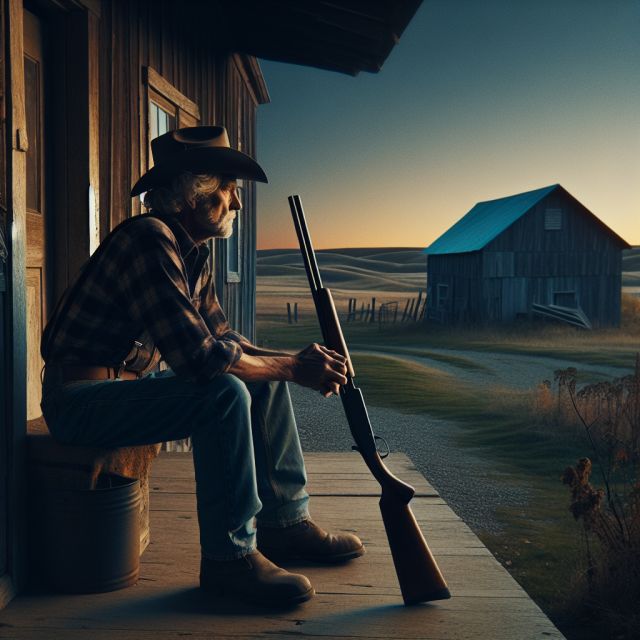
Someone had been there. Likely more than one night, bedding down in his shed as though it were some roadside shelter. Whoever it was, they were gone now, but might return once darkness fell. The thought of the missing saw teeth and the stranger’s quiet occupation of his space settled into a hard knot in his chest. That evening, when the sky turned black and the woods around his homestead fell quiet, he locked the workshop door, then took his place on the front porch. In the stillness, he sat motionless, the double-barreled shotgun resting lightly across his lap, eyes fixed on the silhouette of the shed.
At around three in the morning, he saw a shadow shuffle from the treeline toward the workshop. The figure moved slowly, shoulders sagging, and stopped at the door to try the latch. When it held fast, the man jiggled it again. The old man rose and walked to the edge of the porch, his voice low but steady as he called out, “Don’t move. Stand perfectly still, or you will be shot. ”
The intruder froze, then thrust both hands up into the chilly night air. The old man stepped down from the porch and crossed the yard, boots whispering over the grass. At arm’s length, he flicked on his flashlight. The harsh beam revealed a grizzled former soldier, his beard tangled and gray, wearing filthy, ragged camouflage and an army cap that had seen better decades. The man’s clothes hung loosely on a frame worn thin by too many hungry miles. After a quick glance around to make sure no one else waited in the shadows, the old man asked, “Who are you, and what are you doing on my property?”
“My name’s Tray,” the stranger said, voice hoarse. “Just looking for a place to spend the night. I’m a little down on my luck, and the nights are getting colder. ”
The old man heard no wobble or deceit in the words, but his anger smoldered beneath the surface. “That may be,” he said, “but why did you break off three of my saw’s teeth? That saw’s been in my family for generations. It was meant for my son. Now it’s ruined. What did you need them for?”
Tray hesitated, then slowly bent and pulled up his right pant leg. In the flashlight’s glare, a prosthetic limb came into view, scuffed and patched from years of use. Between the foot and the ankle joint, three metal teeth were fitted neatly in a row, spaced evenly, holding the vital parts of the artificial leg together like improvised pins. The old man realized the soldier had cannibalized the heirloom to keep himself walking.
In the distance, a lone wolf lifted its voice, a mournful howl that hung over the fields. The clouds thinned, letting the moon spill pale light across the yard, the porch, and the two men standing between. The old man lowered the shotgun, feeling the weight of what he’d lost and what the stranger had needed in equal measure. Without a word, he fished a key from his pocket, unlocked the shed door, and nodded toward the ladder inside. Then he turned back toward the house, leaving the upstairs bed ready for the weary soldier who had broken his saw to keep moving through a world that had forgotten him.
— by Tommy (my first attempt at writing a short story)